Thursday, September 15, 2011

Women's Health - Better than Cosmopolitan, not as good as Oxygen

I thankfully got a lot of feedback from my last posting.  Rants are always popular it seems.  


Some of the feedback I got was that I shouldn't expect anything better from Cosmopolitan in regards to fitness articles, but that they though I'd have a point if it was Women's Health.  I'll save my retort to that for the end of this article, but in the meantime let's take a look at Women's Health.  


Their magazine for this month didn't have much in the way of fitness articles.  They did have a 1-page spread on a kettlebell circut however which was pretty decent.  I like kettlebells, they're a lot of fun.  
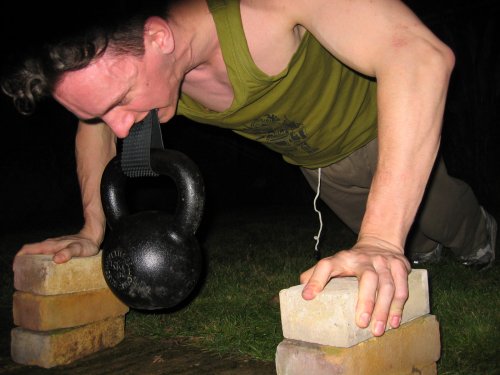

Well, okay, this is just silly.


"The secret to shaving time off your workout without sacrificing results: doing dynamic combo moves that target at least two muscle groups (think quads and biceps) in each rep...they are great time-savers and also challenge your stabilizer muscles which help improve core strength and balance."


True enough!  This is one of the reasons that I like moves such as the squat or deadlift - they work multiple muscles in one movement rather than isolating muscles like one does on machines.  As well since you're using more muscles, you will be saving time doing just a few exercises cover your total body rather than going from machine to machine isolating muscles for no particular reason.  And, as I mentioned in another post, free weights will make you use your stabilizer muscles and improve core strength.


They recommend doing the circuit of 4 exericses they give you for 2 sets with an 8-10lb kettlebell.  I always dislike it when magazines give you a recommended weight.  I get asked this all the time: "What weight should I be using?" If you want a universal answer here it is: Whatever makes the routine difficult for you.  When it comes to doing strength training, the weight should be heavy enough that the last 2-3 reps are strenuous and difficult.  In the case of this circuit, it's going to be whatever makes you want to lay on the ground and die by the end of it.  No, seriously.  Circuits are supposed to be HARD.  They are a combination of strength and cardio that are excellent for getting your metabolism up and burning calories while maintaining muscle.  Not to mention a million times more interesting than running on a treadmill or chilling on an elliptical.  


Has clearly progressed from the 8-10lb recommendation


They don't give you a rest interval between sets either, which is also important and a component many seem to forget about.  For circuits I usually say 60-90 seconds.  As well it should be mentioned that a workout like this should not be your entire routine for a strength day unless it's a rest day and you just have a compulsion to go and workout. (That's not just me right? .....right...?)  Something like this should take place after you already do your strength training at the end of your workout.  You could also do this instead of your typical cardio day. (Assuming your goals are physique-related and you don't have specific running goals.)


The four exercises they give you are a little complicated for a beginner and require some serious coordination.  However, it's in no way a bad routine.  Hooray!


So in an effort to get some more out of Women's Health, I picked up "Women's Health Ultimate Weight Loss Guide," something apart from their usual monthly magazine.  80% of the book is about diet, which is great.  Diet is about 80% of the battle when it comes to weight loss, a point they make in the beginning of the guide.  Unless you're a teenage boy, it's hard (impossible for most) to out-exercise a bad diet.  However this is not a nutrition blog so I'll leave all that part alone.


Let's get to the fitness part!


First fitness chapter they have is entitled "Fast Track to a Fit Body," because I guess the title "The slow and steady track with moderate, over-time changes to a fit body" just is never enticing.  In this article they'll be talking about interval training and high-intensity training.  The tagline for this chapter is "The workout secret that will slash pounds - and the time you spend in the gym."  This annoys me.  This isn't a 'secret.'  Fitness knowledge is free and available and out there to anyone who cares to take the time to look.  Women's Health isn't selling you something that hasn't already been said before.  I guess that's just me getting uppity over semantics but the language of health and fitness magazines and infomercials really bothers me.


"Is..is that....?"
"Yes, it's the secret....of how to slash pounds."


Anyways, where was I?  Oh yes.  This article.  They cite a study that concluded that interval training will get you the same benefits as a longer, steady-state cardio workout in much less time.  As far as what they mean by 'benefits,' I'm not sure.  Why don't magazines have to cite their sources?  They go on to talk about how to mentally prepare yourself for high-intensity, how to know if you're making a max effort and a couple of examples of interval training.  Then I came upon a wondrous quote that I was very pleased to see:


"Picking up the pace during spin class isn't the only way to pump up your routine.  Programs such as CrossFit and P90X are intense workouts that have women busting out pushups, lifting barbells and swinging weights.  (And no, these chicks don't look like bodybuilders.)" Yaaaaaaaaaaaaay.


Yaaaaaaaaaaaaaaaaaaaaaaay!


"Some women are intimidated when they see a workout like 50 pullups, pushups, and squats because they assume they can't do it...But the challenge empowers them.  They get a chance to do things they thought were impossible."


"There's just now way around it:  If you're not uncomfortable, you're not working hard enough."


There's a tear in my eye.


I'm just so HAPPY!


"Only 20% of your workouts should be high intensity"


....aaaand there it goes. 


 So if you exercise 5 times a week only 1 should be high intensity?  Maybe this is true if you're an athlete during the in-season.  However, CrossFit gives a workout of the day...everyday.  People who do CrossFit do it many times per week.  I do high-intensity work 2-3 times per week.  They give all these lovely quotes about working hard and then tell you to only do it once a week, and that's if you're one of the few people who works out 5 times a week?  Just wrong.  If you're a beginner, yes, chances are high intensity work isn't something you can do more than maybe once a week.  However as you get used to the workload this will change.  The definition of high-intensity also needs to be refined if they're going to put out this kind of statement.  


But, let's not put down Women's Health.  Here's another great quote they give in this guide:


"To burn more fat while weight-training, higher weight, fewer reps instead of lower weight, more reps."


Yaaaaaaaaaay.


However, Women's Health does not hold a candle to Oxygen in the fitness department.  If you want good info on exercise and fitness Oxygen is definitely the way to go.  It's targeted towards women, however the information is just as applicable to men.  Their models actually look like they workout.  It's shocking, really.  They have success stories from readers every issue who go on to do powerlifting, figure competitions, bikini shows, etc. from their advice.  One of their readers submitted in a sarcastic piece of mail that takes after my own heart: 


"I hate the gym!  A friend took me to her gym for a workout last week.  I hated it.  There were too many sweat-covered grunting gorilla types.  I had to get out.  I realize that Oxygen is a big promoter of weight lifting, but sorry guys, Oxygen just isn't right for me.  I get much more from Shape magazine because they don't believe in strenuous exercise - and neither do I.  When I feel an urge to exercise, I lie down until the feeling goes away."


From the cover you wouldn't be able to tell how good this magazine is, except for the fact the cover girl has meat on her bones.


So I'm going to transition here onto the retort I got back the most from my last blog post; that no one should expect good fitness information from Cosmopolitan - it's Cosmopolitan.  It'd be like expecting an electronics magazine to have a decent article on fitness.


Well, if an electronics magazine decided for whatever reason to write an article on fitness, I would indeed expect them to have decent information in it.  If you're going to put out any kind of writing on any topic to the public, if you're going to give advice to anyone about anything, you better know what you're talking about.  Cosmopolitan covers a variety of topics and frequently fitness is one of those topics.  Whether or not their main focus is telling women how to have better sex, if they are going to write about fitness they should write with care and with an informed opinion.  The whole idea that people don't expect good information from Cosmo is telling.  Considering how many women (okay so it's probably a lot of 14 year old girls reading how to give better blow-jobs also) read the magazine and take it for truth should be enough argument to say that we should expect better.


Well this is probably the longest post I've written!  If you made it this far, congratulations!  You win my gratitude! 

Wednesday, September 7, 2011

It's Rant Time

While one day perusing men's and women's magazines for the content of a new post, I noticed something disturbing.


One of the main fitness contributors for Men's Health is Alwyn Cosgrove.  One of the frequent contributors for Cosmopolitan is Tracy Anderson.  Now my first post already dissected some of Tracy's....questionable advice.  But I'm sure most people don't know who Cosgrove is (except for fitness nerds!) so let's compare these two:


Alwyn Cosgrove (http://alwyncosgrove.com/about/)


Cosgrove owns one of the top gyms in the country, has written hundreds of articles on the subject of exercise and sport performance, and is a sought-after lecturer by fitness professionals.  He is endorsed by other big names in the field such as Mike Boyle, Joe DeFranco, Mike Robertson, Dave Tate, Eric Creesey, the list goes on.  Also note how his website has archives of all of his blog posts and articles available to you for free.  Just take a look at a couple and you'll know this man is the real deal and a true expert.


Tracy Anderson (http://tracyandersonmethod.com/tracy/)


Anderson has no formal education in exercise, anatomy or physiology that we know of.  All that's said is that she did extensive personal research into the field, which tells us essentially nothing.  In the fitness professional community she is seen as a bit of a joke.  Not much more can really be said about her credentials.  She has none other than being able to say she's trained celebrities.  Let's take a look at when Kelly Ripa went for a visit to her studio:


Note how when Anderson speaks about exercise, she never really says anything.  Not one thing that comes out of her mouth makes any sense or says anything substantial.  It's like listening to a politician give talking points.  I mean really, just look at that cube.  What is that?  What is the science behind what she does?  (Hint: there isn't any)


Let's look at an article written by someone who went through her exercise and diet plan: 


http://www.dailymail.co.uk/health/article-1367879/Gwyneth-Paltrows-personal-trainer-Tracy-Andersons-diet-plan-gave-blackouts.html


Key notes to take away from that article:
-Anderson's diet plan puts you on a 700 calorie a day diet with mostly non-solid food.  (Good luck keeping up with that)


-2 hours of exercise a day 6 days a week. (Good luck keeping up with that when you're only eating 700 calories a day)


-"Tracy is totally against other forms of cardio, such as running, where you repeat your movements over and over. That, she says, will bulk muscles."  I'm sorry has she ever even LOOKED at a marathon runner?  They're TINY.  Oh wait, you can run for free.  You have to buy her super special cardio routines.


Gosh just LOOK at how bulky she is!  I mean I guess that's a female, it's just so bulky it's hard to tell.

Even men with their 10x more testosterone than women are small when they are marathon runners.

- "I would go to bed so hungry that I could hardly sleep.  I feel faint on several occasions and in the middle of Oxford Street everything starts to black out." Anderson's method backed by the hard science of "If you literally starve yourself, you will probably lose weight."

-"There are no fats (in the diet)"  Yeah those aren't necessary for essential bodily functions or anything important like that.

- "On the downside I feel woozy and find it difficult to concentrate. At first I had loads of energy but now I'm always tired and am told I'm horribly grouchy to boot.  My skin is terrible and my nails are flaking and weak. And  -  how can I put this  -  my system has become, shall we say, somewhat sluggish. Normally I'm as regular as clockwork. Not any more."  The price we pay to have someone tell us how to be anorexic for beauty.

-A real, actual dietitian is appalled by the diet and says "I see patients suffering with anorexia nervosa and now I'm reading their diet in pamphlet form."  Ohhh SNAP.

-Author makes posts on Anderson's support forums with the dietitian's findings and questioning Anderson's methods; posts are deleted.

- "Jo Doust, professor of physiology at the University of Brighton, says there's nothing new or magical about Tracy Anderson's exercises.

He says: 'She claims you can re-engineer your muscular structure and defy your genetics through her programme, but you just can't do that.
'You can develop your muscles but you can't defy your genetics. Her exercises aren't special  -  you could get a similar plan from any trainer in any gym.'"  Except you wouldn't from any legitimate trainer, unless you said "I want to spend money without getting results, what do you have for me?"

-Gwenyth Paltrow, one of Anderson's big-star clients is also her business partner.  Is there a wonder why she endorses her products?  Oh, and she also has osteopenia, the precursor to osteoporosis.  Fun!

So why do other celebrities train with Anderson?  She probably has a great personality and is fun to work out with.  She probably sells herself very well.  Is it so hard to believe that celebrities are as easily duped by good salespeople as anyone else?  Why do some people continue to go to psychic healers, use magnet therapy or buy and endorse a shake weight? 

And let's not forget there are other celebrities.  Cameron Diaz works out with A-Rod.  Jessica Biel works out with Jason Walsh. (A fellow UNC-CH graduate, whose entire list of celebrity clients is available on his website).  Both lift weights that are (GASP) more than 3-5lbs which Anderson swears will make you bulky.  Just look at these hulking offenses against femininity: 


You both disgust me with your manliness and lack of osteoporosis.


Just to throw it in your face more, here is a whole video of various women and various body types lifting heavy objects for varying repetitions:


$10 says these women eat more than 700 calories a day.  Another $20 says that they can take all their groceries inside in one trip.

So I feel like I've gotten off my original point of Cosgrove vs. Anderson.

Why does Men's Health deserve a reputable expert such as Cosgrove, but Cosmo readers get the joke of fitness professionals?  I can only assume it is the continued wide-spread ignorance about women's fitness, which is only perpetuated by people like Anderson.  

Will you get slightly more muscle than Paltrow if you lift weights?  Sure.  But I'm here to say that muscle is GOOD.  Muscle is what is going to make you look tighter, firmer, leaner, more sculpted, whatever crazy buzz-word you want to use.  Muscle is what makes Biel's butt look firm while if you just do cardio all day and diet like crazy it will probably be tiny but flabby.  Muscle is what will make your underarm less flabby. 

Is it worth osteoporosis, an excruciating, unrealistic, near-anorexic diet, 2 hours of cardio 6 days a week, and not having enough strength to support yourself to look like this 


Instead of this?


I doubt it.

P.S. This is a great blog post by Dean Somerset about how to tell an expert from an "expert":  

Wednesday, August 17, 2011

Abs are Sexy, the Core is Sexier

So in my last post I feel I interchanged the words "core" and "abdominals" a little too freely.  Let's take a look at the differences, because it's an important concept.


These are abs:


Yay.


More specifically, these are the abdominal muscles:

Sexy.


Alternatively, this is (some of) the core:

Mmm look at that multifidus.


The abdominal muscles are also part of the core, which is comprised of 29 muscles in total.  The core is also often referred to as the "lumbo-pelvic-hip complex."  This pretty much just means the lumbar area of the spine, the pelvis and hips are included in the core, along with the thoracic and cervical spine.  If you'd like to get real specific, here is a list of some of those muscles to get an idea:


- Levator Ani (Pelvic Floor)
- Coccygeus (Pelvic Floor)
- Transverse Abdominis
- Internal Obliques
- External Obliques
- Rectus Abdominis
- Multifidus
- Erector Spinae
- Latissimus Dorsi
- Trapezius 
- Gluteus Maximus
- Quadratus Lumborum 


So, there is a lot more to the core than most people probably think.


The core serves a number of purposes.  Some important ones for many today is posture and spinal stabilization.  A lot of lower back pain can be attributed to a weak core.  Other functions (that are just as important but seldom thought of) include: efficiently generate and absorb force and correct distribution of weight.  The core is essentially your foundation, and a strong foundation is needed for any structure.


The importance of core training is one reason why I dislike the use of machines in strength training.  Let's take a look at the difference between a row machine and a bent-over row with a barbell:


Here you are in a seated position, with no core activation required to keep us steady and stable.  The machine does that for us.  The weights are on a track and you don't have to guide or control the movement.


Let's look at the difference here.  In order for the man to keep his spine straight (like we talked about with the planks!) the core has to be activated and strong enough to maintain stability.  As well, the weights are not a fixed track, so in order to do the movement correctly there must be some amount of control and stability in the latissimus during a rep.  Try doing these two exercises and see if you can feel the difference in core activation and difficulty!  Which one is more strenuous?  Which one will get you more reward for your time?


This can be applied to a number of machine vs. free weight exercises.  Dumbbell Overhead Press vs Overhead Press Machine:


Laid back in a comfortable seated position.


Must keep core stable to prevent excessive curving of the lower back.


Etc!

So if you do a routine with free weights instead of machines, you can be working on core stabilization the whole time without doing a specific core exercise.  Of course, this doesn't mean you shouldn't include core work in a daily routine.  

Once again, thanks for reading!

Monday, July 25, 2011

False Promises Skew Expectations

Every month, without fail, men's and women's magazines will have some kind of bit that gives you exercises for "Flat abs" or to "Lose that belly" or "Tone your thighs in 5 minutes!"  Do these sound familiar?  I just made these up off the top of my head but let's see how close I got by inspecting some covers.


Help!  I'm being assaulted by large block letters giving me attention-grabbing easily-digestible messages!


All this took was a quick google image search and these pictures were within the first 5 links.  Is it possible that there is a new secret to weight loss and losing belly fat every month?  Did the one from last month not count anymore?  


Let's delve in and see what these magazines advocate.


From Self Magazine this month,  we have "One Easy Move to Slim all Over."  And it's the exercise that everyone loves to hate: The Plank.


http://www.self.com/fitness/workouts/2011/08/flat-abs-in-5-minutes-slideshow?intcid=trail0725


The form here is correct save one point: It is not proper to smile while planking.

Listen up, crunches and sit-ups: Be jealous - very, very jealous! - of the middle-minimizing powers of the plank....you put a stop to muffin top while also firming your back, butt and shoulders.  


Well, they've got one thing right, crunches and sit-ups suck.  For many people they'll induce neck pain and even though this can be corrected, why bother when there are a million better ways to do the same job?  Here's a fun study on different sit-up and crunch variations:


"Crunches require less effort and less strain on the hip and lower back," Dr. Chong said. Also, interestingly, crunches are harder on the neck. "When the body is vertical (as during a full sit-up), the neck gets a break."
The most strenuous sit-up is a full sit-up from the floor, he said, noting its activation of muscles in the abdomen, back, shoulders, hips and legs."


(From http://www.eurekalert.org/pub_releases/2003-08/mcog-rpv081503.php )


What's this?  A sit up doesn't just work just the abdominals?  More fun facts: it is actually the hip flexors (More specifically the iliopsoas) that do most of the work in a full sit-up.  Use this as an excuse to never do them again.


And crunches...well let's be real.  How much effort does it take to do a crunch?  How many crunches do you need to do to get any kind of significant calorie burn?  How much are the abdominals REALLY getting worked with such a short range of motion?  Save yourself some time and do a more efficient exercise.


Getting off the tangent, let's get back to this article and planking.  The article gives us a model using proper form and schnazzy work out clothes.  


Adjust your arms: Keep them in line with wrists...shrug off the urge to hunch your shoulders to ears, which makes the move harder to hold.  You want every belly-firming second!


Get in line: Neck should be long...look a few inches in front of your hands to align head and spine.


Straighten out: A flat back is the key to flat abs.  The transverse abdominis engages to stabilize the spine and hold you as stiff as a board.  Drop or lift your hips and you let your abs off the hook.  Assume the position by a mirror, and do a form check.


This is all great advice for form!  With the plank we want to keep our spine in a straight line, and they make sure to point out that this includes the cervical vertebrae of the neck.  The way we keep our hips from sagging (And causing some bad lower back pain, which they point out as well!) is by activating our core to keep the hips up.  What does 'activate the core' mean?  How can you know if you're doing it correctly?  Here are some verbal cues I use with my clients to get them to feel what I mean:


-Think about drawing your bellybutton in towards you spine.
-Suck it in like you're trying to put on a pair of jeans that don't really fit anymore. (I'm pretty sure most people can relate to this one.)
-Brace yourself like you're about to get punched in the gut.


A noble effort! 


As well, to see if you're doing it right, take Self's advice!  Look at yourself in the mirror and check if your spine is straight.  Use your phone to record yourself to make sure you keep proper alignment the whole duration.  If you're starting to shake in the middle, chances are you're doing it right.  Another way some people will skimp on form is by bringing the hips up too high and making the lower body do some of the work.  Remember, your entire body is supposed to be stiff as a board, hence the name plank!


However, the amount that you're firming your back, glutes and shoulders is going to be minimal.  In my first post I mentioned that I hate the word toning and it simply means losing fat and gaining muscle; the exact same things apply to the word 'firm.'


We then get a lot of assorted plank variations that will work the different abdominal muscles.  These are all core exercises to be certain.  They include a combination of isometric  (Contracting muscles in a static position, such as in a normal plank.), multi-planar (Such as in the "Sculpting Sweep.") and single-planar (Such as the 'Perfect Pike" or "Play it Straight.") movements.  


But there are still a few things that irk me about articles like this.  How often are you supposed to do these exercises?  Why are you supposed to do them?  Why am I not getting the promised cinched waist and flat abs from doing these exercises?  Should I do this month's exercise suggestions to get flat abs or last month's?  


Self suggests to "Spend five minutes most days" doing these various exercises.  If you're just starting out, chances are you won't be able to do these exercises 'most days.'  Your abs will be so sore by the next day you probably won't be able to do it again for at least a week.  On the opposite side of the spectrum, what do you do when these exercises get too easy?  How do you progress?


If I was to give suggestions, for a novice instead of spending a workout doing exercises targeting one area, try a total-body routine and mix up the different muscle groups.  This will prevent you from feeling too sore to function in your arms, or abdominals or quadriceps, etc.  For someone more advanced who is no longer feeling challeneged, add weight.  For some reason the magical numbers for dumbbell weight is 5 to 8 in most magazines.  What weight you use is going to be different for every person.  Some people can't handle any, while 8 pound would be almost the same as using nothing to others.  Try doing the plank with a weight plate on your back.  Alternatively, you can move the plank down to your elbows or challenge yourself to hold one for 3 to 5 minutes.  


(Adding weight to your plank can help achieve this as well as simply practicing planks for duration.  As we pointed out in the first post increasing your strength will make doing something lighter for endurance easier)


Correct form for the elbow plank with a straight spine with proper hip alignment, baggy T-shirt, frowning face full of pain and messy apartment.  


What's the difference between this month's and last months suggestions?  Probably not much.  It will just be more variety of core and abdominal exercises, which is good to mix up your routine with and keep things challenging.  Obviously though there will be a good amount of overlap; with at least 5 magazines giving "Flat Ab" exercises every month there's bound to be some repeats.


Why are you not going to actually get flat abs from these exercises?  I'll give another very important point that is CONSTANTLY gotten wrong by trainers, magazines, and infomercials and applies equally to men and women:


THERE IS NO SUCH THING AS SPOT REDUCTION.  The only way to reduce body fat in a specific area is to reduce fat overall.  Doing a million abdominal exercises will not specifically reduce your belly fat.


Find yourself using this machine in hopes of trimming those thighs?  Don't be surprised when it doesn't work.   


Whew.  Good to get that off my chest.  So this point has a silver lining: This means that even if you spend a day doing upper body work, if you're achieving fat loss you'll be reducing body fat in the lower body as well.  Of course, there can still be areas that are stubborn and want to hold the majority of your fat: typically the hips and thighs for women and the midsection for men.  This does not mean that fat will not be reduced in these areas!


Want to know the exercise that is "One Easy Move to Slim All Over," or the exercise that will "Flatten Your Abs in 4 Easy Steps"?


There isn't one.  There is no easy exercise that will accomplish any of this.  You could try squatting though.  That's a good start.


Thursday, July 21, 2011

Fitness Advice in a Magazine that Makes Sense: Awesome!

After the absurd advice from our last post, I thought it would be a good idea to follow with actual good advice from the popular women's magazine, Glamour, on how to have a better workout:


The real talent in the magazine industry is how to make the same topics sound like something different every month.


(http://www.glamour.com/health-fitness/2010/07/how-to-burn-more-fat-at-every-workout#slide=1)


So let's go through point by point and give a bit more background rather than the 2-3 sentence blurb they get.


1) Workout Fat-Burner: Pump up the pace.
Need proof that working up a serious sweat will help you slim down? When women added high-intensity jogs or walks to their weekly exercise routine, they lost about two inches from their waist over four months


While the title of the article is how to burn more fat, which is true in a sense, what you're actually doing for some of the advice they'll be offering is burning more calories in general by doing more intense work.  The more intense our workout is (judging intensity by a percentage of our maximum heart rate), the more we actually use carbohydrates as the fuel source.  The less intense, the more fat is utilized.  This chart gives an idea of the carb:fat ratio for various intensities:


Intensity % MHR% Carbohydrate% Fat
65 to 704060
70 to 755050
75 to 806535
80 to 858020
85 to 909010
90 to 95955
1001000


MHR stands for maximum heart rate.  From this chart, one may think that doing low intensity exercise is the key for body fat reduction.  However, bear in mind that a 30-minute low-intensity workout does not burn nearly as many overall calories as a 30-minute high-intensity one.  So if we do a workout that burns 100 calories at 65% MHR, that's 40 calories of carbs and 60 of fat.  (Roughly; protein does play a part, but such a small one it is typically discounted)  However, if we do a workout that burns 200 calories in the same time at 80% MHR, that's 130 from carbs and 70 from fat.


As well, we shouldn't think of using fat as a fuel source as being the only way to lose body fat.  A calorie is a calorie no matter the substrate used.  If you burn carbohydrates to fuel your muscles in a high intensity workout, carbohydrates you take in after that will go towards refilling your muscle stores rather than being converted to fat.  It's just a different path to get to the same end.  The most common idea is that strength training = building / keeping muscle, cardio = fat loss.  In reality both burn calories and both are good for changing our body composition.  In fact, if we JUST do cardio for fat loss, our body tends to use our muscles as a fuel source, reducing the amount used by fat! (In addition to making for a flabby physique!)


A not flabby physique


2)Workout Fat-Burner: Adjust the length of your workout.

It’s a no-brainer that working out longer can help you boost the burn, but how much longer? According to a study in the Journal of the American Medical Association, women who logged about an hour of moderate activity every day gained little or no weight during a 13-year period.

Well this one doesn't really need explanation.  Exercising longer burns more calories.  Exercising an hour longer burns more calories than exercising 30 minutes longer (assuming intensity stays the same).  In other news, the sky is blue, more on this report at 7.

Accompanying photo to this point on the original article.  I too make intense Oooooo faces while curling 5lb dumbbells on the beach.


3) Workout Fat-Burner: Turn up the tunes

Listening to music during your workout can motivate you to push yourself harder, thus boosting your fat-burning ability. When women underwent a cycling test, they performed better with music than without. And during a strength-training workout, women could perform more repetitions before reaching fatigue while listening to loud music versus soft music or no music.

Very true!  Music is a huge motivator and can make us want to push it further than before.  This is why all group fitness and cycling classes have music to push you (for a dance class like Zumba) or relax you (for classes like Yoga).  Of course, this is a completely subjective point.  Some people like complete silence, and I have a friend who listens to classical music while he lifts.  Different strokes!


4) Workout Fat-Burner: Drink milk.

Moo juice can do more for you than build strong bones. When women drank about four cups of fat-free milk after their strength-training workouts (half immediately after exercising and the other half one hour later), they lost more fat in 12 weeks than women who drank a carbohydrate beverage, according to a study published in Medicine & Science in Sports & Exercise

Another very good point.  After a bout of weight training taking in a 4:1 combination of carbohydrates and protein is a very good idea (Hence why milk is a solid choice.).  The carbohydrates helps the protein get absorbed and put to use repairing muscle fibers that tear during training, as well as restores our muscles sources of carbohydrates.  It's best to get this drink in up to an hour after your workout, when your body is most receptive to using the nutrients to restore muscle glycogen.  


(Also a good excuse to drink chocolate milk)


5) Workout Fat-Burner: Try intervals.

Although it can be tough, interval training may torch flab faster than a regular workout. In one study, individuals completed 10 exercise intervals, doing four minutes of super-hard work followed by two minutes of rest. The upshot? Interval training helped them burn more fat

We covered why this is true in the first point, and also brushed on interval training in the last post.  Good to see magazines advocating this now.


6)Workout Fat-Burner: Sip tea.

The next time you need to quench your thirst, slug some green tea. A study published in the American Journal of Clinical Nutrition found that men who consumed the equivalent of roughly five cups of green tea during a 24-hour period before doing a 30-minute moderate-intensity workout burned more fat than men who took a placebo

Caffeine before workouts does increase the amount of fat loss because caffeine increases the amount of free fatty acids circulating in the blood and will be used more over carbs / protein.  However the effects of this can and most likely will diminish over time as you keep taking in caffeine.  As well, these are not drastic increases in fat metabolism so don't expect this to be the answer to all your fat-loss woes. 


Hopefully soon I'll put up analysis of another Glamour fitness article from this month's issue as soon as I can get my hands on a copy.  As always, thanks for reading!